
The 7 Fundamental Movement Patterns: Your Key to Greater Everyday Mobility
Movement is life – and the more natural the movement, the better for our body. But what exactly makes a movement "natural"? The answer lies in the 7 fundamental movement patterns that form the foundation for practically every activity in our daily lives. In this article, I'll explain what these movement patterns are, why they're particularly important from age 50 onwards, and how you can train them effectively.
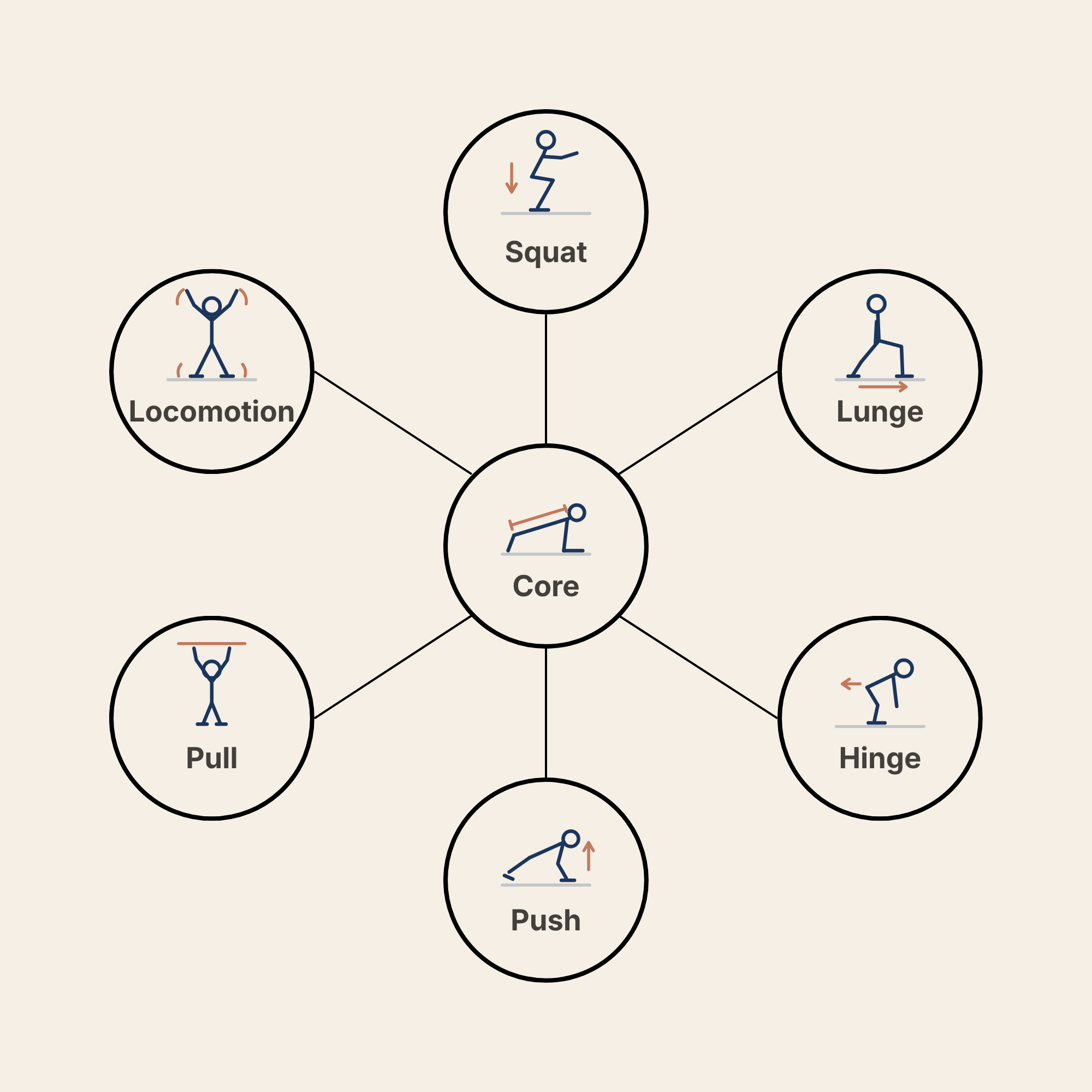
The 7 Fundamental Movement Patterns
Why the 7 Movement Patterns Are So Important
Imagine you want to:
Get up from the sofa
Carry a shopping bag
Play with your grandchildren
Turn over in bed
Reach something from a high shelf
In all these everyday activities, you use the fundamental movement patterns. They are the "building blocks" of every movement. The better we master them, the easier these daily activities become and the longer we remain mobile and independent.
The 7 Movement Patterns in Detail
1. Squat
In daily life: Standing up and sitting down
Strengthens leg and gluteal muscles
Improves balance
Makes you fit for all situations where you need to stand up or sit down
Supports coordination between mobile extremities and a stable torso
2. Lunge
In daily life: Climbing the stairs, stepping forward.
Improves your balance
Strengthens legs individually
Makes you more confident when walking and on stairs
Trains stability on one leg – important for safe walking
3. Hinge
In daily life: Lifting and bending
Protects your back when lifting
Strengthens the posterior chain
Particularly important for back-friendly working
Helps you keep your spine neutral whilst picking things up
4. Push
In daily life: Pressing, pushing away
Strengthens shoulders and arms
Improves posture
Helpful for overhead work
Enables you to catch yourself or push yourself up
5. Pull
In daily life: Pulling in, holding on
Strengthens the back
Improves posture
Important for many household activities
Prevents the "rounded back" posture that becomes more common with age
6. Core
In daily life: Stability, the basis of every movement
Technically speaking, the core is not a movement pattern but a stabilising function. I nevertheless list it as a separate pattern because it forms the basis for all the others and is engaged in every single one. Some systems list rotation as a separate pattern instead. Rotational movements are relevant to everyday life – looking back whilst driving, for example – but they primarily engage the core and can be combined with other patterns, such as lunges with rotation.
Core stability:
Protects your back during all movements
Sustainably improves your posture
Gives you stability in everyday life
Reduces the risk of back injuries
Enables safe and controlled rotational movements
A stable core is like the foundation of a house – without this foundation, the other movement patterns cannot function optimally either.
7. Locomotion
In daily life: Walking, running, climbing, crawling.
Increases your endurance
Improves coordination
Keeps you mobile and independent
Trains the cooperation of all other movement patterns
Why Training These Patterns Is So Important from Age 50 Onwards
With increasing age, we naturally lose muscle strength and mobility – if we don't do anything about it. What's special about the fundamental movement patterns: they are the foundation for an independent, active life. When these patterns function well, we can:
Remain independent for longer
Reduce the risk of falls
Manage daily activities more easily
Prevent back pain
Have more energy in everyday life
How You Can Train the Movement Patterns
The great advantage of these movement patterns is their versatility. Each pattern can be trained at different difficulty levels:
Start gently: Begin with simple variations that you can control well. The quality of the movement is more important than the number of repetitions.
Focus on technique: Pay particular attention to:
Controlled, slow movements
Stable core
Conscious breathing
Neutral spine
Progress gradually: Increase the demands step by step when you feel confident. Each movement pattern offers various variations for every fitness level.
Stay consistent: Short, regular practice sessions are more effective than infrequent, long training sessions. Even 20-30 minutes can make a big difference.
Discover the variety of bodyweight training and calisthenics...
Conclusion: The Path to Greater Everyday Mobility
The 7 fundamental movement patterns are the key to an active, independent life – especially from age 50 onwards. What's special about them? You train exactly the movements you need daily. No complicated equipment, no hours-long workouts – just natural, effective movements that help you in everyday life.
The best part? Anyone can train these movement patterns, regardless of their current fitness level. With the right exercises that build on your level, you can train the patterns effectively – and that in short, regular sessions that integrate well into your daily routine.